Laying Out a 3×3 Metre Exhibition Booth
Nine square metres is enough when laid out well. How to split the space into three bands, set graphic heights, and avoid five common mistakes.
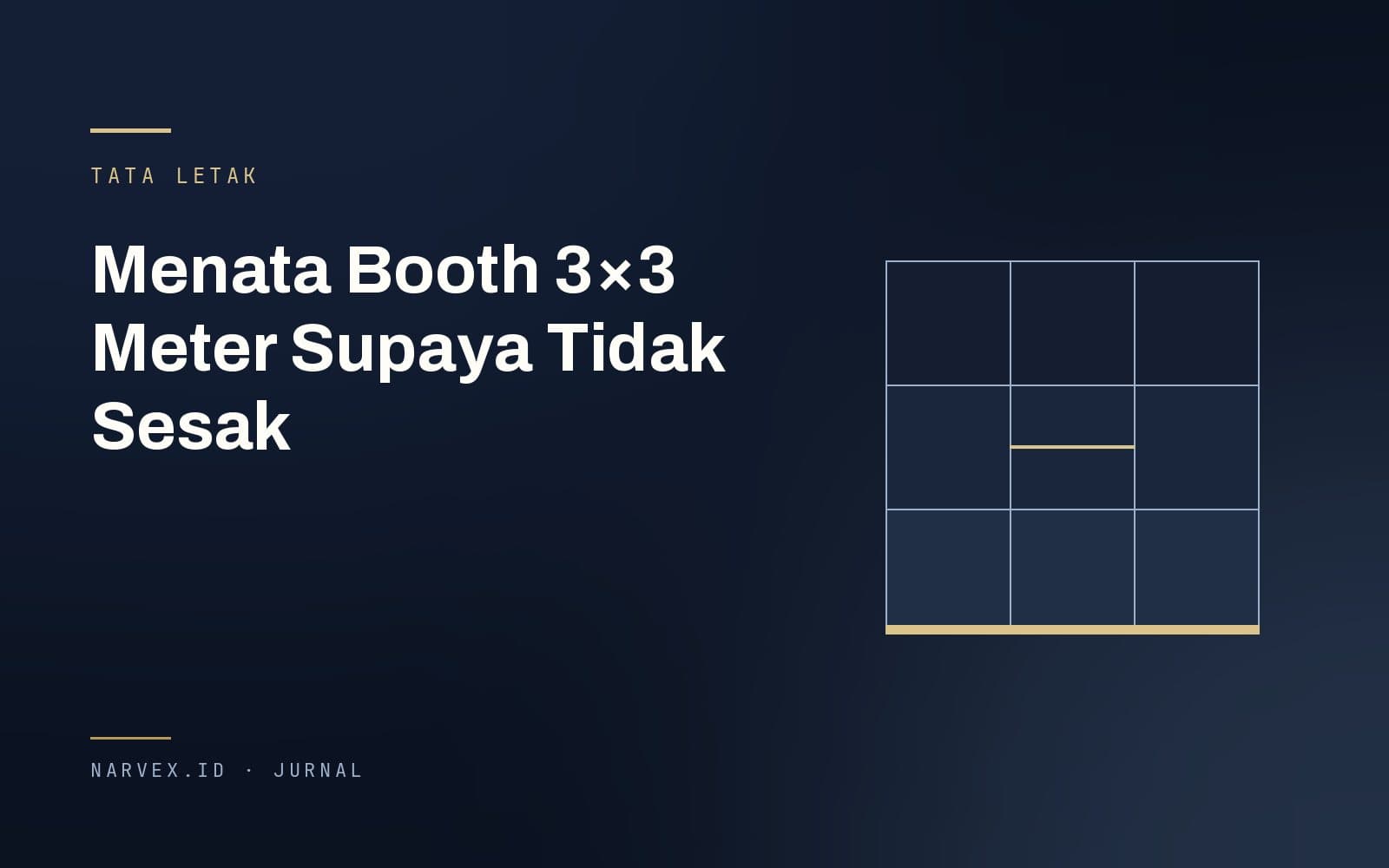
The 3×3 metre stand is the most common size at almost every trade show in Indonesia, and also the one most often laid out in a way that makes it feel smaller than it is. Nine square metres is genuinely enough — provided you decide first what work the space has to do, then remove everything that does not support it.
Here is how to lay out a 3×3 metre stand so it stays open, reads from a distance, and does not have your booth staff hunting for things all day.
Start with one sentence, not a floor plan
Before drawing anything, write one sentence: what you want a visitor to do at this booth. Look at a product. Try a sample. Leave their contact details. Book a demo. Ask an engineer a question.
That sentence decides everything else. A booth whose job is collecting contacts needs a standing-height counter and a fast flow. A booth that explains a technical product needs somewhere two people can stand side by side facing a screen for ten minutes. Both do not fit in 9 m², and trying to accommodate both produces a booth that serves neither well.
Divide the space into three bands
The most reliable way to lay out a small stand is to split it into three bands running parallel to the aisle, each roughly one metre deep.
Front band: attract
This is the most valuable metre in the whole booth, and the one most often filled with a table blocking the way in. Leave it open. The only things that belong here are what makes someone stop walking: one hero product, one screen, or one clear visual element.
Middle band: hold
Where conversations happen. A counter, products people may touch, or a demo screen. Leave room for two visitors to stand without having to step back into the aisle when someone else arrives.
Back band: close off
Back wall, storage, and somewhere for staff to put their belongings. Everything visitors should not see lives in this band — not under the front table.
Put graphics at eye level, not in the middle of the wall
The mistake you see most often down an exhibition aisle: the brand name placed exactly in the centre of the back wall, then blocked by the heads of the people standing in the booth.
Divide a 2.5 metre back wall into three zones:
- Below 100 cm — nearly always hidden by a counter, products or people. Put nothing important here.
- 100–170 cm — the reading zone. Products, short explanations and the main visual.
- Above 170 cm — the zone visible from across the aisle. Your brand name and one descriptive line belong here, as large as you can make them.
A simple test before printing: shrink your wall design until it is the width of your palm. If the brand name and what the company does are still readable, the sizing is right.
Pay attention to where people arrive from
Visitors do not see your booth head-on. They see it from the side, while walking, often mid-conversation with someone next to them. That makes the side facing the flow of traffic as important as the front.
If your stand is on a corner with two open sides, do not close one off just to gain graphic surface. An open side is an expensive asset — in any quotation, corner stands cost more precisely because of it.
Lighting beats almost everything else
Exhibition halls are generally lit evenly and somewhat dimly. A booth brighter than its surroundings will look better than a booth with a more expensive structure and mediocre light.
The two spotlights included in a stand package are usually not enough. Add light aimed at the graphic wall and at the product area, not at the empty floor in the middle of the booth.
Storage is part of the design
Every exhibition booth accumulates things visitors should not see: spare brochure boxes, staff bags, drinking water, cables and consumables. With no planned home, all of it ends up under the front counter — visible from the aisle, all day.
Allow one lockable counter-height cabinet in the back band. The space it costs is far less than the impression of clutter it prevents.
Five mistakes that recur on 3×3 stands
- A table across the entrance. It physically blocks people from entering and turns the booth into a service window.
- Too many messages. Visitors read your booth in under three seconds. One main message, not six.
- Staff seating facing inward. Someone sitting with their back to the aisle makes the booth look empty.
- Every product on display. On a small stand, showing everything means nothing stands out. Choose three.
- Graphics printed from low-resolution files. They look fine on a laptop and fall apart at wall size.
Questions we get asked
Does a 3×3 metre stand need a custom booth?
Not necessarily. At this size the biggest impact comes from graphics, lighting and layout rather than the shape of the structure. Many of the best 3×3 stands use standard partitions with a finished front wall and a custom reception counter. The trade-offs are set out in custom booth or R8 system booth.
How many people should staff a 3×3 metre stand?
Two per shift. One person leaves the booth empty every time they go to the toilet or to lunch; three people in 9 m² make visitors feel there is no room to step in.
Can we nail or glue into the organiser's partitions?
Usually not, and damage to rented partitions normally carries a replacement charge. Make sure your graphic mounting method complies with the venue rules — this is one of the things we check before production starts.
Next step
Once you know your stand size and show dates, send them through our contact page. We will come back with a layout proposal and a cost estimate. For an example of a small stand we have built, see the SPG Kefii booth at Grand City Mall Surabaya, and our full scope of work is on the exhibition booth contractor page.
Related articles
Booth Brief: 12 Things We Need to Quote
A complete brief turns a quotation around in one working day. The twelve things to send us, plus an example brief written in a single paragraph.
August 13, 2026
Modular Booths: One Build, Many Shows
Four construction decisions that let a booth be reinstalled, a numbering system crews actually use, and when a modular booth makes no sense.
August 13, 2026

Booth Materials: Plywood, HPL, Duco, Acrylic
Plywood, MDF, steel hollow, HPL, duco, acrylic and tension fabric — what each is good at, and when to choose it for your exhibition booth.
August 13, 2026