Booth Materials: Plywood, HPL, Duco, Acrylic
Plywood, MDF, steel hollow, HPL, duco, acrylic and tension fabric — what each is good at, and when to choose it for your exhibition booth.
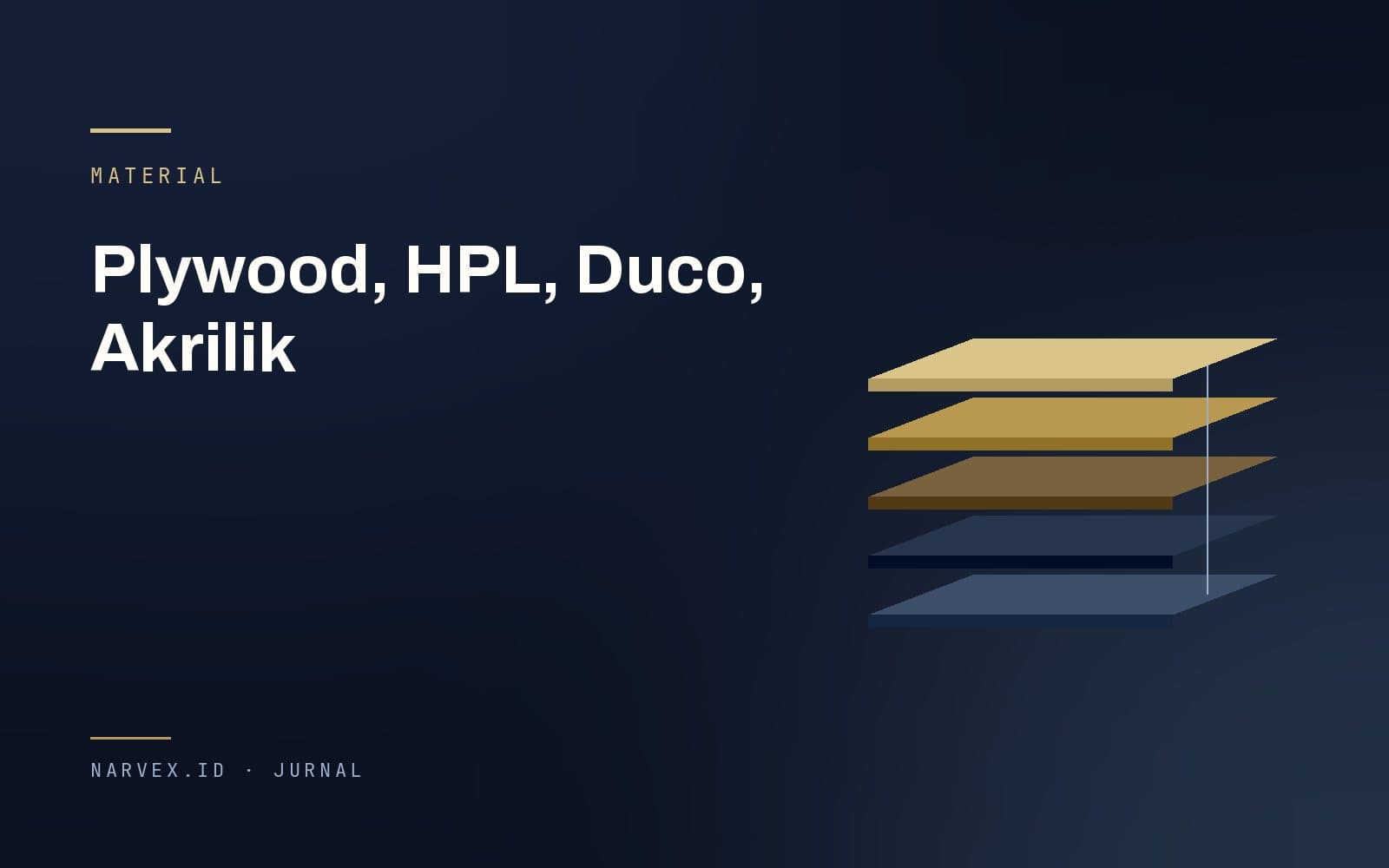
Two booths built from identical drawings can look very different once they stand in the hall, and can differ noticeably in cost. The reason is almost always materials and finishes — the part of a quotation clients ask about least, even though it determines the result most.
This guide covers the materials commonly used for exhibition booth construction and furniture, what each is good at, and when to choose it. Everything described here is work we carry out ourselves in our workshop in the Rungkut area of Surabaya.
Structure: what holds your booth up
Plywood
The backbone of most custom booths in Indonesia. Strong, cuts accurately, holds screws well, and accepts almost any finish. Twelve and fifteen millimetre are the usual thicknesses for wall panels; eighteen for load-bearing surfaces such as counters and product shelving.
Its drawback is weight, and weight means transport cost and crew numbers at load-in. On a structure that will be reinstalled in another city, this is a real consideration.
MDF
Far flatter than plywood, which makes it the best base for duco paint. But MDF is more fragile at edges and corners, holds screws less well, and is permanently damaged by water. Right for decorative panels and smoothly painted surfaces, wrong for framing.
Steel hollow section
Used when a structure has to be tall, span wide without columns, or carry heavy loads such as large screens and oversized products. More expensive and it requires welding, but nothing replaces it for double-deck structures or suspended planes.
Modular aluminium systems
R8 or Maxima profiles, assembled without nails. The fastest to install and the friendliest to repeat use. We compare them with custom construction separately in custom booth or R8 system booth.
Finishes: what visitors see
HPL (High Pressure Laminate)
Laminate sheet bonded to a plywood surface. The range of colours and patterns is very wide, including wood grains and solid colours. Its main strengths: scratch resistance, easy cleaning, and predictable lead times because nothing has to dry.
Its limit is form. HPL struggles around tight curves, and the joints between sheets will show on a very wide plane. For a booth against a deadline, HPL is almost always the right call.
Duco paint
Sprayed paint built up in layers with sanding between coats. The result is seamless, jointless, and able to follow any shape — including curves and rounded corners. The colour can be matched exactly to your brand, which HPL cannot always achieve.
The price is paid in time. Duco needs several days for drying and sanding, and it cannot be rushed without spoiling the result. It also scratches more easily during handling, so it needs more careful packing.
Acrylic
Used for raised lettering, backlit panels and translucent elements. Very effective at drawing attention, because it is the only element on a booth that emits light rather than reflecting it.
It needs precision cutting and careful handling — acrylic cracks if forced, and scratches on the surface cannot be removed.
Tension fabric
Printed fabric stretched over an aluminium frame. The lightest, fastest to install and easiest to transport — the fabric folds into a case and the frame assembles on site. Reprinting for the next show is also far cheaper than rebuilding a wall.
Its limit: fabric carries no load, so nothing can be shelved or screen-mounted on it. For brands that exhibit regularly, fabric frames for the large walls combined with timber construction for counters is a very efficient pairing.
ACP (Aluminium Composite Panel)
Flat aluminium-faced panel. Even, modern and weather-resistant, which makes it the choice for outdoor booths or elements exposed to rain. Indoors, ACP rarely delivers an advantage worth its cost.
Choosing without becoming a materials expert
Answer these three questions and the options narrow by themselves:
- How much production time is left? Under two weeks points to HPL and fabric; duco needs room to dry.
- Is the structure single-use or reusable? Reusable points to modular systems, framed fabric and bolted joints rather than glue.
- Is the form straight or curved? Curves point to duco or fabric; flat planes work well in HPL.
One thing that gets forgotten: how this will be moved
Materials are chosen in a meeting room but judged at the loading dock door. A panel too wide for the goods lift has to be recut on site, and an emergency cut is never as clean as a workshop cut.
So the maximum panel size should be settled at the same time as the material — not after the design is locked. The details are in our load-in and load-out guide.
Questions we get asked
Which lasts longer, HPL or duco?
HPL resists day-to-day scratching and knocks better, so it lasts longer on structures that are frequently dismantled and rebuilt. Duco is easier to repair in place — a scratch can be touched in with paint, whereas lifted HPL means replacing a whole sheet.
Can an old booth be refinished rather than rebuilt?
Often yes, and often far cheaper. If the frame is still sound, replacing the surface layer and the graphics can make a booth look new for well below the cost of building again. Send us photographs of your existing structure and we will tell you whether it is worth keeping.
Are environmentally friendlier materials available?
The most meaningful way to reduce exhibition waste is not switching board types but designing a structure that can be reused. A booth used four times generates far less waste than four single-use booths in any material.
Talking through your requirements
If you have design drawings and want to know which materials make sense for your budget and schedule, send them through our contact page. For furniture, reception counters and product shelving, see our custom exhibition furniture page.
Related articles

Booth Brief: 12 Things We Need to Quote
A complete brief turns a quotation around in one working day. The twelve things to send us, plus an example brief written in a single paragraph.
August 13, 2026
Modular Booths: One Build, Many Shows
Four construction decisions that let a booth be reinstalled, a numbering system crews actually use, and when a modular booth makes no sense.
August 13, 2026
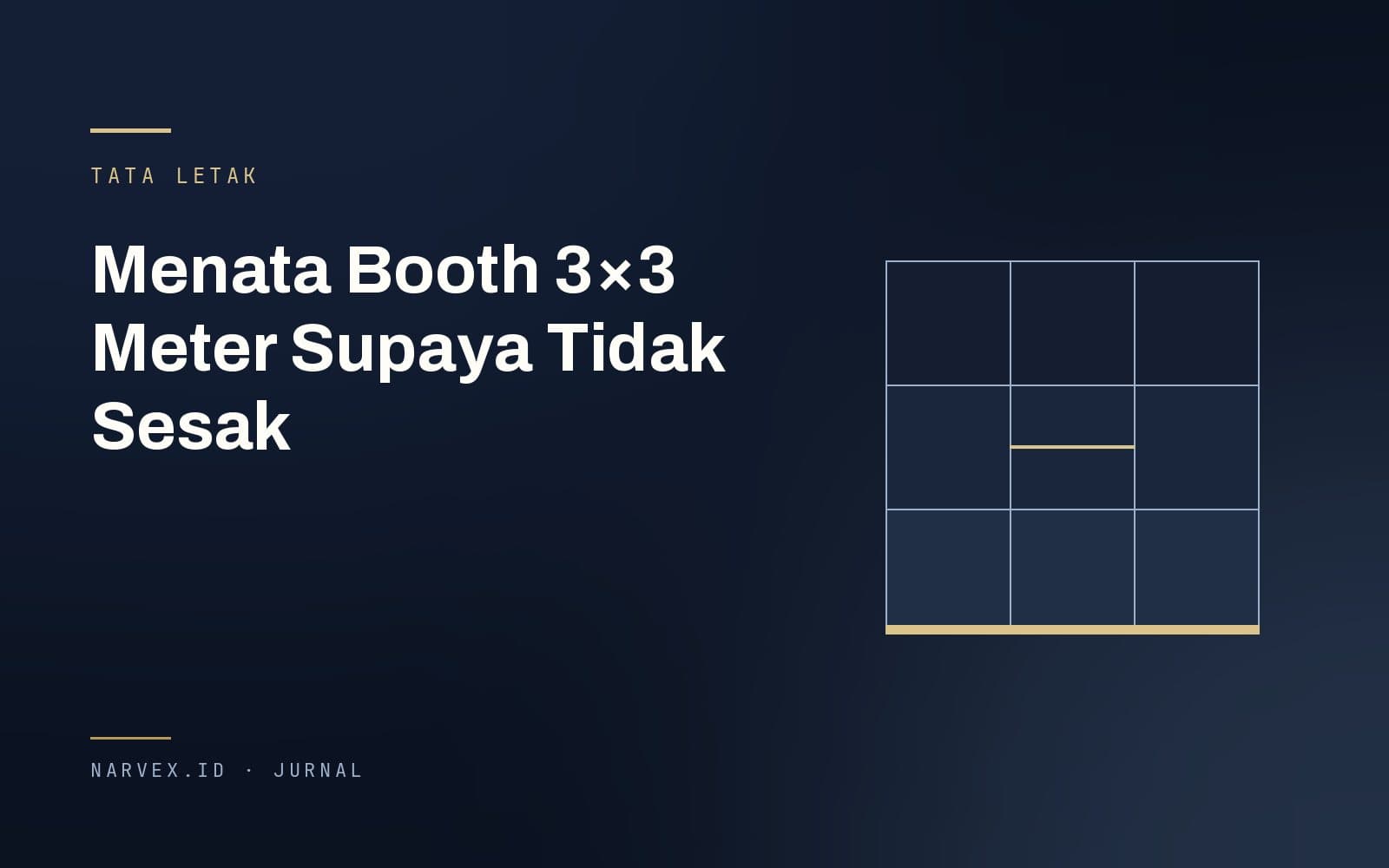
Laying Out a 3×3 Metre Exhibition Booth
Nine square metres is enough when laid out well. How to split the space into three bands, set graphic heights, and avoid five common mistakes.
August 13, 2026