Booth Brief: 12 Things We Need to Quote
A complete brief turns a quotation around in one working day. The twelve things to send us, plus an example brief written in a single paragraph.
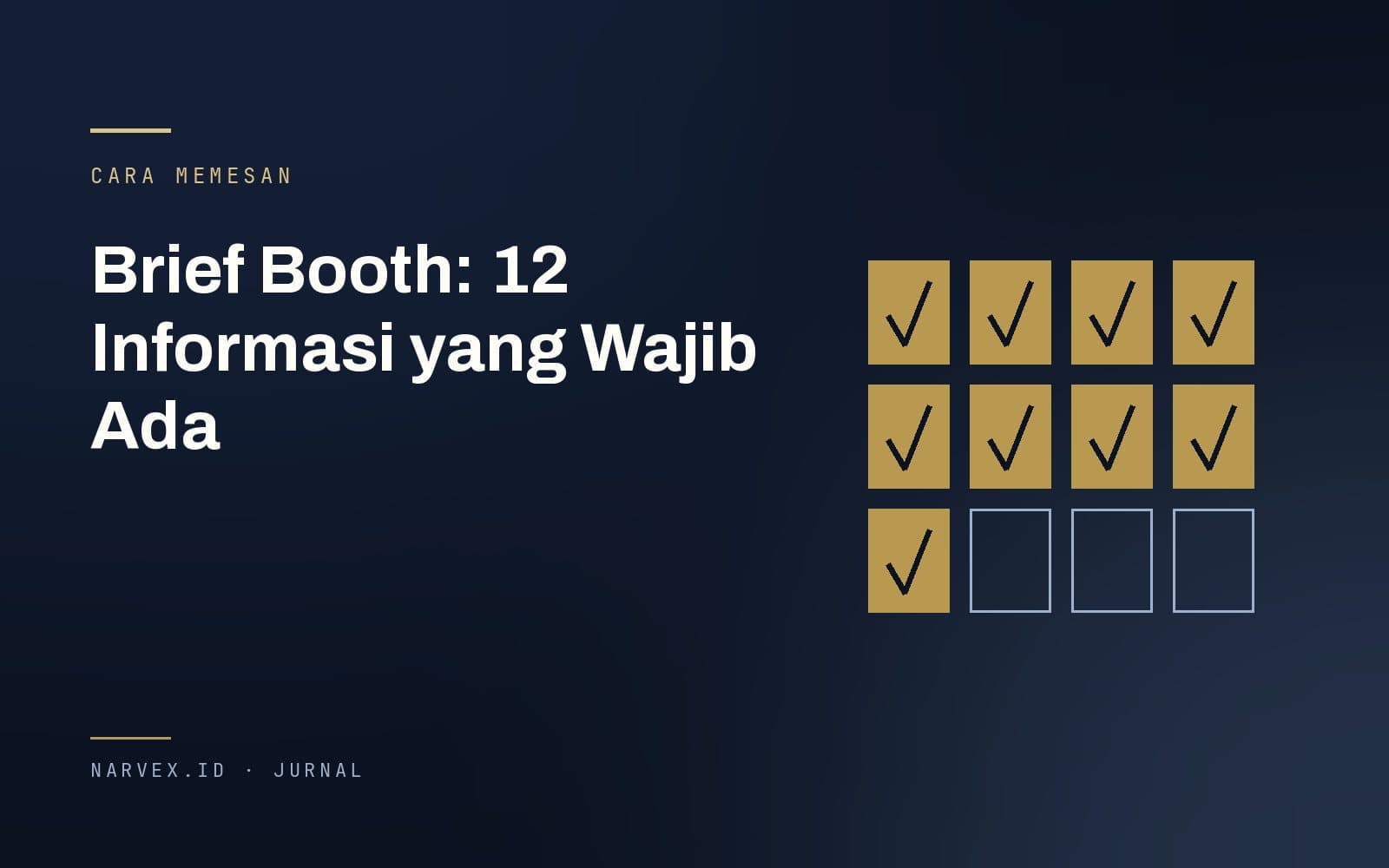
The gap between "we need a booth" and a meaningful cost estimate is usually filled with two or three rounds of questions. Almost all of that can be removed if the first brief is complete — and complete does not mean long. The twelve points below fit in one message.
This list is drawn from the questions we most often have to ask back. Send all of it at once and a quotation can be with you within one working day.
What sets the scope
1. Show name and venue
Not just the city. The venue determines construction rules, the load-in route, and any official contractors you may be required to use. Two venues in the same city can have very different requirements.
2. Show dates and load-in date
Both, not one. Load-in often falls one or two days before opening, sometimes overnight, and that is the real production deadline.
3. Stand size and number of open sides
Write length × width in metres, then state the position: mid-row, corner or end of row. This changes finishing costs significantly — the reasons are in exhibition booth cost components.
4. Stand number and hall plan, if you have it
The plan shows which direction visitors arrive from, who your neighbours are, and where the hall entrance sits. All of that affects which way the booth should face.
What sets the form
5. What a visitor should do at your booth
One sentence is enough: look at products, try samples, talk to an engineer, or leave contact details. That sentence shapes the layout more than any design reference does.
6. What will be displayed, with sizes and weights
Machinery, vehicles, refrigerated products, large screens, or simply brochures. Heavy items affect floor construction and how they are moved in; tall items affect sightlines across the whole booth.
7. How many staff will be on the stand at once
This sets circulation space and seating. A small stand with five people on it feels full before a single visitor steps in.
8. Visual references, including ones you dislike
Two or three reference images already help. What is rarely sent but equally useful is an example of a booth you think is wrong — it saves more time than the ones you like.
What sets feasibility
9. The organiser's maximum construction height
It is in the exhibitor manual. If you have not had time to look, just say so — we will ask, but knowing it up front prevents a design that has to be rebuilt.
10. What your stand package already includes
Many organisers already provide partitions, a nameboard, two lights, one table, two chairs and one socket. Rebuilding something you have already paid for is the easiest waste to avoid.
11. Budget range
The point most often left blank, and the most damaging one to leave blank. Without a range, a vendor has to guess — and a wrong guess costs both sides time. A rough range is enough; an exact figure is not needed.
12. Whether the structure will be used again
If it will, it is designed differently from the start: bolted joints, panels cut to transport size, graphics separated from the structure. The considerations are in our modular booth guide.
What a complete brief looks like in one paragraph
Hello, we need a booth for an industry show at Grand City Convex Surabaya, 12–14 October, load-in on the evening of the 11th. Stand is 6×3 metres, number B-12, a corner with two open sides; hall plan attached. The aim is to collect distributor contacts, so we need two discussion counters and space to display three table-sized products. Four staff working in shifts. Maximum construction height 4 metres, and the package already includes partitions and two lights. References attached — we want a clean impression, nothing too busy. Budget is in a certain range, and we plan to reuse the structure at the January show.
A brief like that can be costed straight away. Without the budget and reuse points, the reply would be a question rather than a quotation.
What you do not need to prepare
Some things get postponed because clients assume they must be complete first. They do not:
- A finished design. That is our job. References are enough.
- Final print files. Needed close to production, not when asking for a quotation.
- A materials list. Describe the result you want; we will recommend materials to suit the schedule and budget.
Questions we get asked
What if I do not know the stand number yet?
Send what is certain. Size and dates are enough for an initial estimate; the stand number affects detail, not the scale of the work.
Do I have to state a budget?
Not compulsory, but it helps enormously. Without it we send two versions — a simple one and a full one — so you have a comparison, and that costs one extra round of time.
How quickly does a quotation follow a complete brief?
One working day for the estimate. Visual proposals take longer, depending on the size and complexity of the stand.
Send your brief
Copy the twelve points above, fill in what you know, and send it through our contact page. If a point is unclear, write "not known yet" — that is still useful information. Our scope of work is on the exhibition booth contractor page.
Related articles
Modular Booths: One Build, Many Shows
Four construction decisions that let a booth be reinstalled, a numbering system crews actually use, and when a modular booth makes no sense.
August 13, 2026

Booth Materials: Plywood, HPL, Duco, Acrylic
Plywood, MDF, steel hollow, HPL, duco, acrylic and tension fabric — what each is good at, and when to choose it for your exhibition booth.
August 13, 2026
Laying Out a 3×3 Metre Exhibition Booth
Nine square metres is enough when laid out well. How to split the space into three bands, set graphic heights, and avoid five common mistakes.
August 13, 2026