Custom Booth or R8 System Booth?
An R8 system booth goes up in hours; a custom booth follows your design. Six criteria for deciding which one your next exhibition needs.
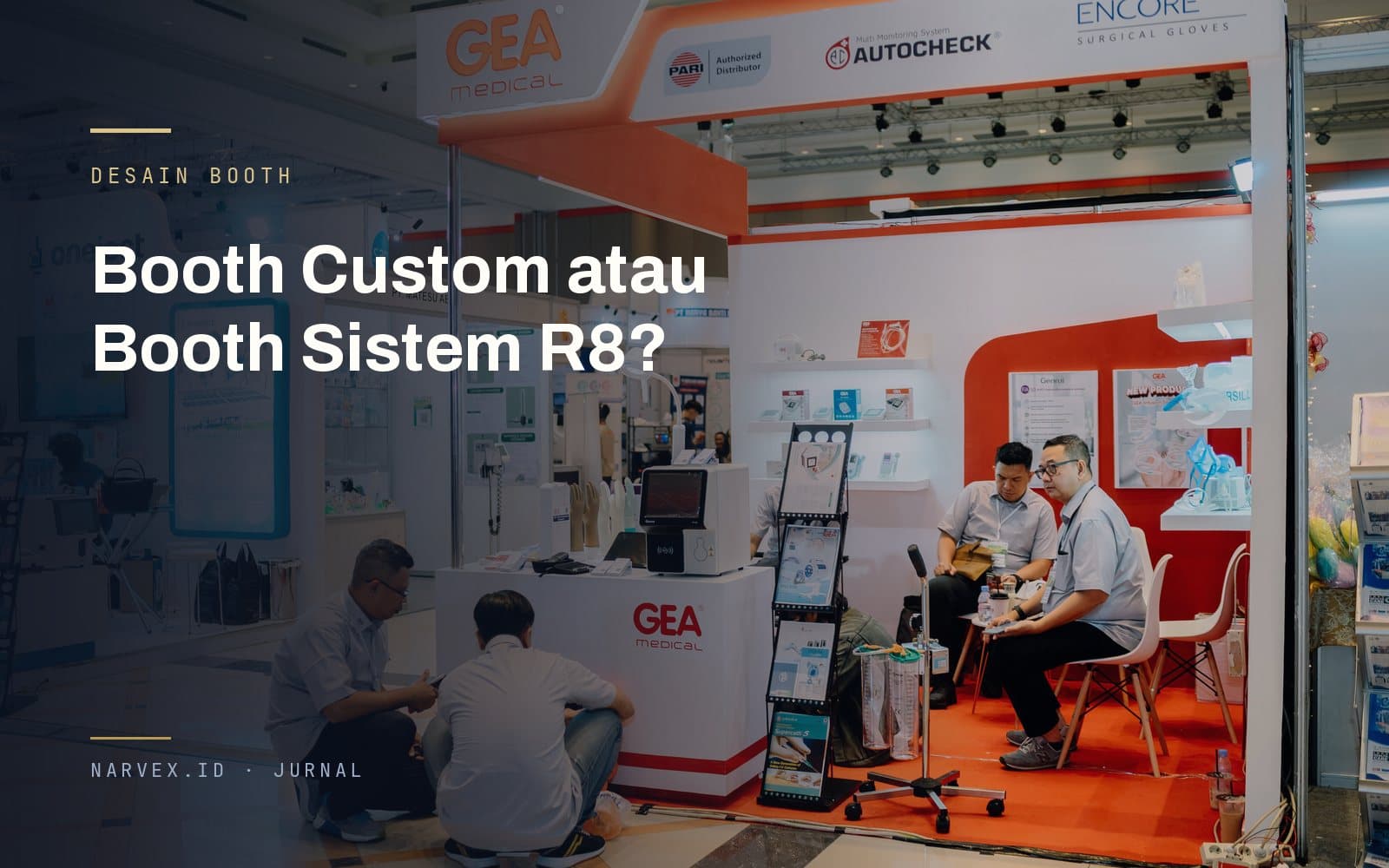
Every time a brand receives its stand confirmation from an exhibition organiser, the first question is almost always the same: use the standard partition system that comes with the package, or build a booth from scratch? The answer is not about which is better. They solve different problems, and choosing the wrong one usually becomes obvious on day one of the show — when your booth disappears among its neighbours, or when the budget has gone into a structure that stands for three days.
This article sets out the technical difference between the two, then gives you criteria you can apply before you contact a contractor at all.
What a system booth is (R8, Octanorm, Maxima)
A system booth is a modular structure of aluminium profiles and panels, assembled on site. In Indonesia the one you will meet most often is R8 — frequently called Octanorm, after the original system. Panels come in standard sizes, typically one metre wide and around 2.5 metres tall, and clip into an aluminium frame without nails or glue.
Maxima is a comparable modular system with a heavier profile, often used for stands that need a more substantial look or a double-deck structure.
What defines a system booth:
- Assembled and dismantled in hours, not days.
- Panels are reused across shows, so the cost per use is low.
- Dimensions follow the system's module — you fit the design to the module, not the other way round.
- The organiser's shell scheme package usually already includes partitions, a nameboard, two spotlights, one table, two chairs and one power socket.
What a custom booth is
A custom booth is built to your design: a timber frame, or timber and steel, with panels cut to shop drawings, finishes chosen surface by surface, and details — curves, suspended ceilings, product shelving — that no standard module can produce.
The trade-off is a longer process: drawings are approved first, fabrication runs in the workshop, then the structure travels to the venue for installation. At Narvex that fabrication stage happens in our own workshop in the Rungkut area of Surabaya, which means a late change does not have to queue at a third party's bench.
Six criteria for deciding
1. How many shows your brand does in a year
One show a year rarely justifies the cost of a custom structure that is dismantled after three days. Four shows a year changes the arithmetic completely — especially if the structure is designed to be reinstalled. If that is your situation, read our guide to modular booths for repeat exhibitors.
2. The stand size you were allocated
On a 3×3 metre stand there is very little room to experiment, and most of the visual impact comes from graphics and lighting rather than from the shape of the structure. From 6×3 metres upward, custom design starts to have something to work with: visitor flow, a semi-private discussion area, and storage that stays out of sight.
3. The height you are allowed to build to
Organisers almost always cap the maximum height, and often set different limits for island stands and perimeter stands. Some elements — hanging banners, gateways, a brand name above the ceiling line — are only realistic as custom work, and only where the venue rules allow them.
4. When you can approve the design
This is the most underestimated variable. A system booth can still be delivered when time is short. A custom booth cannot: the schedule is set not by the show date but by the approval date, because production starts only after it. Our exhibition preparation timeline lays out the sequence week by week.
5. What your booth actually has to do
A booth whose job is to hand out brochures and collect business cards has different requirements from one that must demonstrate a 200-kilogram machine, or host twenty-minute private consultations. It is this functional need — not design taste — that usually pushes the decision toward custom.
6. The organiser's rules on contractors
Some organisers require their official contractor for certain work, or charge a supervision fee for structures built by outside vendors. Ask about this before the design is locked, not after.
The middle path people often miss
Many of the best stands are neither one nor the other, but a combination. The base structure uses the system partitions already included in the organiser's package, with custom elements added exactly where they are most visible: a finished front wall, a purpose-built reception desk, product shelving and additional lighting.
This approach keeps construction costs down while protecting quality in the area visitors actually look at. For a small stand on a tight budget, it usually beats forcing a full custom booth out of compromised materials.
A checklist before you contact a contractor
- Stand size, and how many sides open onto the aisle.
- The organiser's maximum construction height.
- What is already included in your stand package.
- Load-in date, permitted working hours, and load-out date.
- Available power capacity and how it is ordered.
- What a visitor should do at your booth — look, try, discuss or buy.
- Whether the structure will be used again at the next show.
Those seven points are enough to produce a meaningful estimate. The full list is in the twelve things a booth brief must contain.
Questions we get asked
Is a system booth always cheaper?
For a single use, almost always yes. But if your brand exhibits several times a year and rents partitions each time, the accumulated rental can approach or exceed the cost of owning a modular structure. Do the sum per year, not per show.
Can a custom booth be dismantled and reinstalled?
It can, provided it was designed that way from the start — bolted joints, panels cut to transport size, and a numbering system so the crew in the next city knows which panel goes where. A custom booth built without reinstallation in mind usually gets damaged on its first dismantle.
How long does a custom booth take to build?
It depends on size and structural complexity, and what matters most is when the design is approved. Tell us your show date when you send the brief, and we will tell you the design approval deadline that is still realistic for it.
If you are still unsure
Send your stand size, show dates and venue name through our contact page. We will tell you which makes more sense for your case — including when the answer is to keep the standard partitions and add a few custom elements.
Our full scope of work is on the exhibition booth contractor and custom exhibition furniture pages.
Related articles
Booth Brief: 12 Things We Need to Quote
A complete brief turns a quotation around in one working day. The twelve things to send us, plus an example brief written in a single paragraph.
August 13, 2026
Modular Booths: One Build, Many Shows
Four construction decisions that let a booth be reinstalled, a numbering system crews actually use, and when a modular booth makes no sense.
August 13, 2026
Booth Materials: Plywood, HPL, Duco, Acrylic
Plywood, MDF, steel hollow, HPL, duco, acrylic and tension fabric — what each is good at, and when to choose it for your exhibition booth.
August 13, 2026